
Deed Types in Cumberland County Land Records
Deed records in Cumberland County trace every transfer of land back through the county's history. To search Cumberland County deeds, you look up party names in the land index. Then you match what you find to a legal description or tax map number. A quick search result is only a starting point. The recorded instrument itself holds the details that matter. It lists the parties, the property description, prior references, and any later releases. Anyone working through a title question should read the full deed before drawing conclusions. You can also search Cumberland County property records by address to connect a parcel to its recorded history. Older books, plats, and archive reels extend the chain further back than any online index alone.
| Deed Type | What It Does | Common Use |
|---|---|---|
| Warranty deed | Conveys the stated interest with the warranties written in the instrument. | Review the deed and its covenants for a transfer. |
| Quitclaim deed | Transfers whatever interest the grantor holds, if any. | May appear in family or title-cleanup transfers. |
| Executor or trustee deed | Conveys land through an estate or trust fiduciary. | Trace the court or estate authority as well as the deed. |
| Deed of trust | Records a security instrument against real estate. | Search for later assignments and releases. |
| Release or satisfaction | Records discharge or release of a prior interest. | Pair it with the earlier instrument before judging status. |
A deed and a deed of trust answer different questions. They may even name the same property. The first can convey ownership, while the second concerns a secured debt. Cumberland County's land index also holds releases, lis pendens, and other filings. Those filings can affect a title review. Search by party. Then confirm the document type, legal description, instrument number, and any later releases.
Tracing Cumberland County Grantor and Grantee Names
The index follows parties, not a parcel-only chain. Start with the current owner as grantee, confirm the deed that brought the property to that name, and then take the prior grantor back to the earlier acquisition. Search both sides of each transfer. A spouse, estate, trustee, corporation, or nominal grantee may be indexed separately. As you go, record the instrument number, recording date, document type, book and page when shown, and the tax map or legal description that links each document to the land.
The county's SRA search screens do not advertise a specific wildcard, sort control, or result limit. Treat search concepts as flexible until the interface shows you otherwise. When a name search returns several matches, use the deed's description and prior-instrument references instead of picking the first row.
- Locate the latest deed into the owner shown by the assessor, using the owner as grantee.
- Read the grantor, parcel description, and any prior instrument reference from that deed.
- Search the grantor and grantee index for the earlier transfer, checking spelling and joint names.
- When the date is older than remote coverage, continue with the Clerk's books or archival reels.
- Grantor
- The party who conveys an interest in the instrument.
- Grantee
- The party who receives the stated interest.
- Chain of title
- The sequence of recorded instruments that traces transfers over time.
- Book and page or instrument number
- References used to locate a recorded document or image.
Cumberland County Remote Deed Coverage
Cumberland County's remote land-record route is Virginia Secure Remote Access through COVERS/RMS. The county says access begins March 25, 1988. The statewide SRA notice says a Clerk may enable free index-only access. Images require clerk-authorized subscriber access. The subscriber application goes to the Clerk for review. It must be notarized, and it grants inquiry-only use subject to maintenance and security interruptions. The Cumberland Clerk land-record page states the remote start date and the approved route.
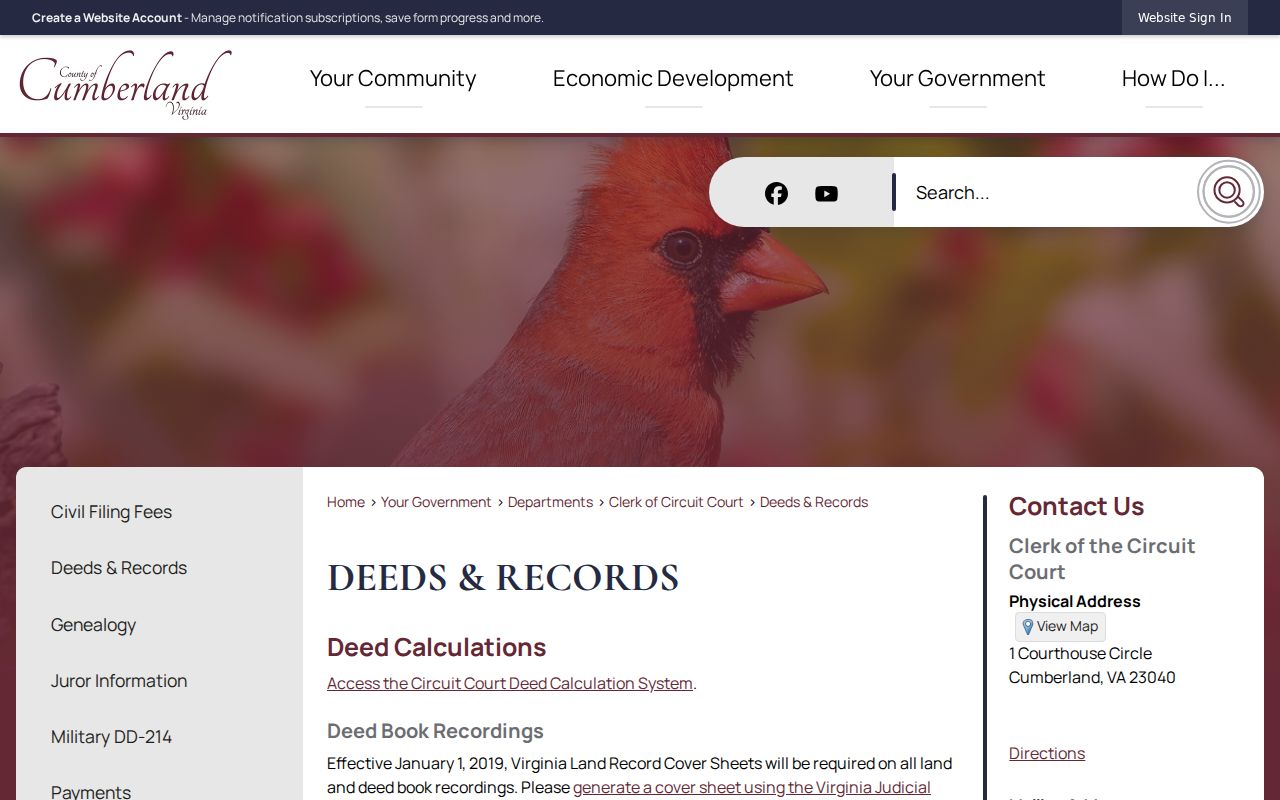
Start with the index when it is available. Then confirm the image's reachability. It may be reachable through an approved account or a Clerk copy request.
The March 25, 1988 date describes the county's remote access coverage, nothing more. It does not mean older books have vanished. Nor does it mean an earlier instrument went unrecorded. For a transfer before that date, use the county's book and index records. You can also find the relevant series in the Library of Virginia catalog. Then ask the Clerk how to inspect or obtain the document.
Index Access and Deed Images
SRA is not a single free image archive. Index-only access may be available without a paid image account. The Clerk must enable it first. The Cumberland RMS application sets the subscriber terms. It asks for applicant and business details. Approval is reserved to the Clerk. The application describes inquiry-only use. It bars resale or distribution of records. Check the current application rather than relying on an old price or access assumption.
The statewide Virginia SRA land-record portal is the official entry point. Its filters, result caps, sort controls, and document-type list vary with the interface. Use only the fields the current screen actually shows.
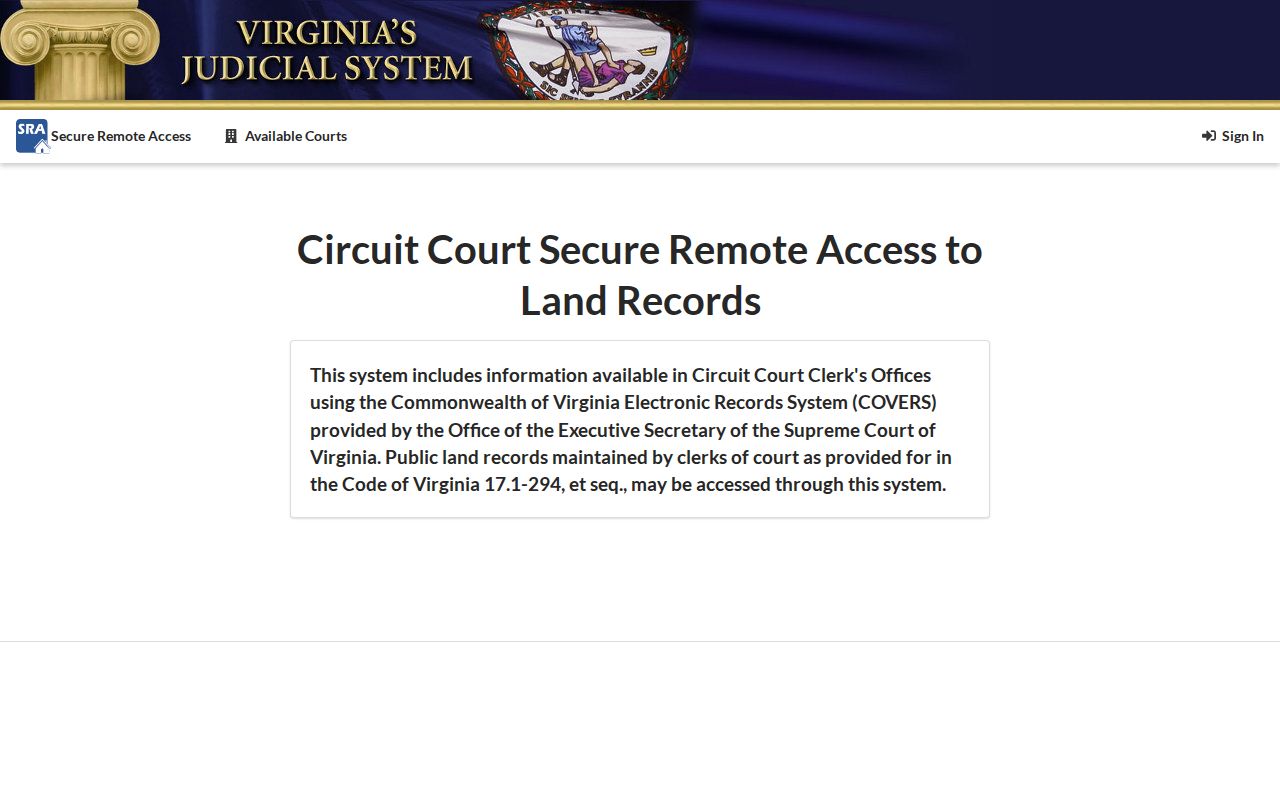
Save the exact book, page, or instrument reference before requesting an image. The Clerk will need it to locate a copy.
Index access and image access are separate steps. A searchable party entry can identify a filing. But the image is not part of a free view. The county's RMS application asks for identifying and business information. It must be notarized, and approval rests with the Clerk. Do not assume an account is automatic. Confirm the current subscription terms on the form before paying.
Cumberland County Deed Books Reach to 1749
Cumberland County was formed in 1749. Deed Book 1 covers 1749 to 1752, and Book 2 runs through 1760. Later reels continue to Book 40. That book reaches 1903. General indexes cover grantors and grantees from 1749 to 1918. Later index material extends through 1975 for part of the alphabet. Plat Book 1 spans 1808 to 1972, and Plat Book 2 spans 1965 to 1970. Release deed books and land-tax reels offer other ways to trace a tract. The Library of Virginia Cumberland catalog names the reel series and their date spans.
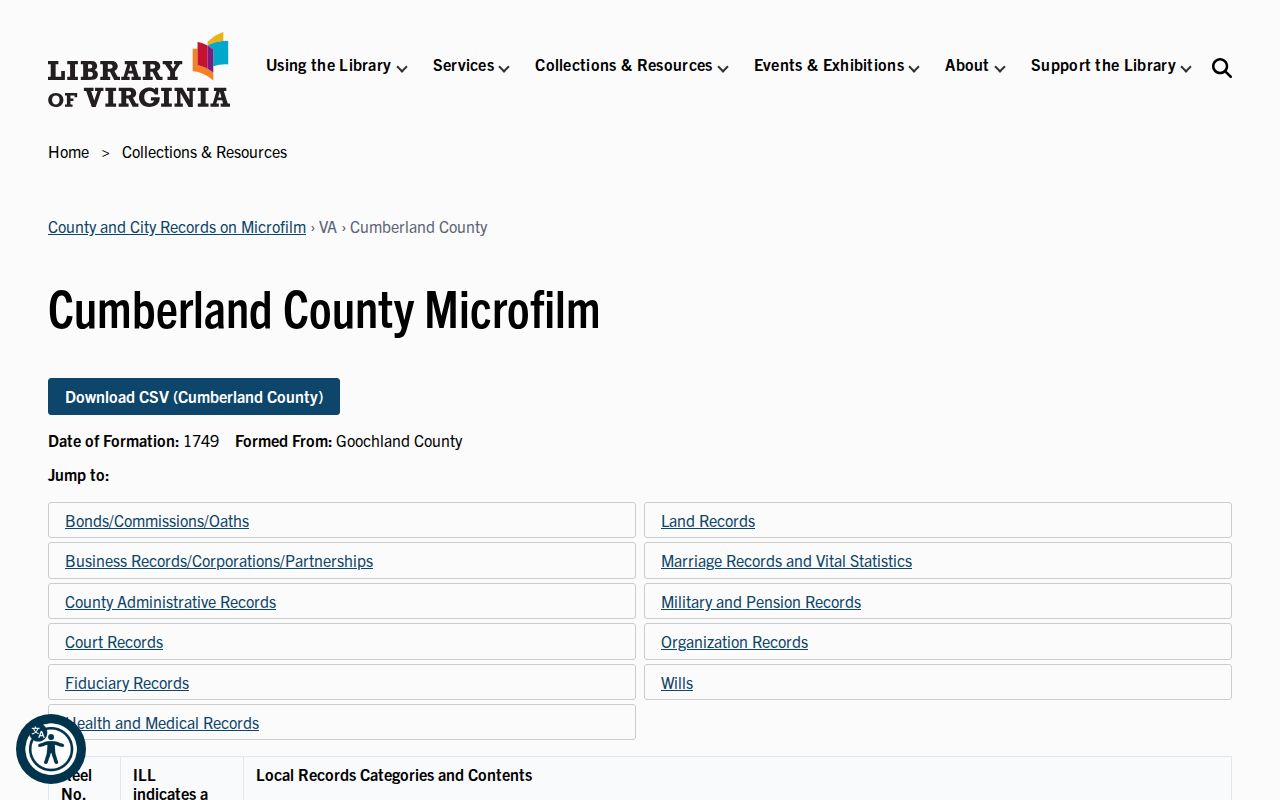
Know exactly what to request before you ask for a reel. The catalog splits the older general name indexes into grantor and grantee runs. It covers A-to-K and L-to-Z portions through 1918. Grantee coverage gets thinner after that, reaching only part of the alphabet by 1975. So one index will not carry every name across every year. The older Cumberland County deed records simply outgrew a single run. When you seek archival help, give the staff the full picture. Say whether your party is a grantor or grantee, and the spelling you tried. Give the likely date range, and the book or index half you want checked.
Gaps in the Cumberland County Index
The Library of Virginia's finding aid flags two index problems. Deed Book 1-A spans 1809 to 1827. It is only partly covered by the general index. Deed Book 3 is described as mutilated. A name search that comes up empty in those spans proves nothing about whether a conveyance actually occurred. So try spelling variants. Inspect the volume itself when you can, and follow references from later deeds back through the chain.
Neither caution means a parcel's title is broken. These are catalog notes, not legal conclusions. Test the chain against deed descriptions. Check recorded plats, release deeds, wills, probate orders, and land-tax books too. If the trail hits an index weakness, record the gap plainly. Ask the Clerk or the Library of Virginia about the underlying volume instead of papering over it with a guess.
Cumberland County Deed Cover-Sheet Clues
A 2025 county cover-sheet sample links party names to a property through instrument type and number, instrument date, page and parcel counts, consideration, and existing debt. It also covers actual or assumed value, tax map number, prior instrument references, a short legal description, and current address. It names the preparer, the payer, and the return address. Those fields are strong leads for pulling the recorded instrument. The cover sheet is not the deed itself. It never carries the full legal language.
The sample uses tax map 099-A-22, a half-acre in the Randolph District. It shows a Cooks Road address with a Farmville postal city. Consideration is listed at $0. Actual or assumed value is also $0. Read those zeros in transfer context. They say nothing about market value.
Other Cumberland County Land Filings
Cumberland County land records hold far more than deeds. Look for deeds of trust, assignments, modifications, and satisfactions. You may also find judgment and mechanic's-lien filings, easements, restrictions, rights of way, and lis pendens notices. A lis pendens signals pending litigation that may touch the real estate. It does not decide who owns the parcel. A lender, trustee, contractor, estate, county, or federal party can be indexed separately. It may appear apart from the current assessor owner.
Search under the owner, the lender or trustee, and the legal description. Always find the later release or assignment first. Do this before treating an older security instrument as still current. Court cases and recorded land instruments are related but distinct tracks. Older or restricted material may require a Clerk counter or public terminal.
Obtaining a Cumberland County Deed Copy
Remote deed images come through the Clerk-approved RMS route. The subscriber form prices individual access at $50 per month for up to 11 months. A full year costs $540. Subsequent and multi-user accounts follow different terms. Treat these as subscription prices for remote access, not a per-page deed-copy fee. The Clerk publishes no current certified-copy or deed-image charges online.
With a book and page in hand, you have a cheaper option. County genealogy instructions say staff can make a copy for $0.50 per page. Visit the Clerk's office at 1 Courthouse Circle, P.O. Box 8, Cumberland, VA 23040, or call 804-492-4442. Hours run Monday through Friday, 8:30 a.m. to 4:30 p.m. Arrive before 4 p.m. for land transactions. Ask about current copy, certification, and payment rules before sending any money.
Filcers can also submit deeds electronically. The Clerk supports CSC eRecording and Simplifile for deeds and land records. For an existing copy, supply an instrument number or book and page when you have one. Otherwise, ask the office what identifying detail a mail request requires.
Recorded, not guaranteed. A Cumberland County deed search shows recorded instruments and may miss unrecorded interests or an index error. Review the deed and later filings, and use a title professional for a title opinion.