
Cumberland County Property Tax Record Fields
Cumberland County property tax records live in two offices. Knowing which one holds what saves time. The Commissioner of the Revenue sets the assessed value on each parcel. The Treasurer keeps the bills, payments, and account history. So start by deciding what you need: an appraisal figure, a tax bill, or proof a payment posted. You can search Cumberland County property tax records by parcel number or account once you know that. Keep the assessment year handy too. Values, installments, and exemptions all attach to a specific tax period.
| Field | What It Shows | Where |
|---|---|---|
| Assessed value | Assessment used to calculate the real-estate levy. | Commissioner property card and land book |
| Land and improvements | Value and building or parcel characteristics when displayed. | Commissioner property card |
| Relief programs | Land Use, elderly and disabled relief, disabled-veteran exemption, and other adopted programs. | Commissioner of the Revenue |
| Tax ticket | Current bill, account balance, and payment status. | Treasurer real-estate inquiry |
| Payment history | Real-estate payment history and yearly taxes paid. | Treasurer e-services |
Virginia law has Cumberland County assessing real estate at 100% of fair market value. Even so, a tax assessment is a mass-appraisal record, not a sale appraisal. A bill then layers on the adopted rate, any relief applied, and payment status. To untangle assessment from market value, see the Cumberland County property value discussion.
Look Up a Cumberland County Tax Bill
The Treasurer's e-services page supports several lookup keys. These include Name, Account Number, Department or Bill Number, and Map ID for real-estate tax searches. Payment-history and yearly-tax-paid inquiries are offered there as well. One quirk: the county's public inquiry page may display a disclaimer gate before the search fields load. So the first screen you see is not always the full form. When the assessment card supplies a map ID, use it. Then verify the bill year and account before reading anything into a balance.
- Open the Treasurer's real-estate inquiry and choose a published key such as Name, Account Number, Bill Number, or Map ID.
- Confirm the parcel and year before reading the amount due or payment history.
- Check the Commissioner's land book separately for assessment and relief-program status.
- If a payment or value is disputed, contact the office that maintains that part of the record.
| Treasurer search key | Use it for | Record caution |
|---|---|---|
| Name | Finding an account when the payer or owner is known. | Names can change after a transfer. |
| Account or Department/Bill Number | Matching a notice or prior account. | Confirm the real-estate department. |
| Map ID | Connecting the tax ticket to the parcel card. | Preserve punctuation and letters. |
- Assessed value
- The Commissioner's fair-market-value assessment used for the land book.
- Tax levy
- The charge computed from assessed value and the county rate.
- Tax relief
- A program that may reduce the amount owed for eligible property or owners.
- Tax lien
- A recorded or statutory claim tied to unpaid taxes; verify status with the custodian.
Carry the tax year with every figure you copy. Assessed value belongs to the Commissioner's valuation record. A Treasurer balance belongs to one bill or installment. A payment-history entry only proves an amount was posted, not that a deed was recorded or a parcel description is right. After a recent purchase, compare the account's map ID and assessment year first; a seller's name on the account may just reflect timing rather than an error.
Cumberland County January 1 Rule
Ownership in Cumberland County gets measured on January 1. The annual land book reflects both the owner of record and the assessed value. Both figures date from that day. Deeds, transfers, surveys, and wills reach the Commissioner of the Revenue weekly. The office stays current in one sense. Still, buy a parcel in March. The land book may list the seller for the rest of the year. The tax bill follows the book. The deed records and the tax roll can name two different people with no error on either side. Neither document is wrong; they simply speak from different moments.
Check recording dates against the assessment year whenever a recent transfer matters. The real-estate tax page spells out the timing rule. It warns that owner changes made after the assessment date may not appear until the following year. When the two records disagree, treat the recorded deed as the stronger title evidence.

When a sale is recent, treat the instrument date and the land-book date as two separate facts. Neither one alone tells the whole story.
Cumberland County Tax Installments
Cumberland County splits real-estate tax into two installments. They are due June 15 and November 15, under the published schedule. The Treasurer inquiry covers the ticket, balance, payment history, and yearly taxes paid. The live form sits behind a disclaimer gate, so check the current portal for field order, the year selector, result display, and print behavior.
The e-Treasurer landing page is the county entry point for real-estate payment and inquiry choices.
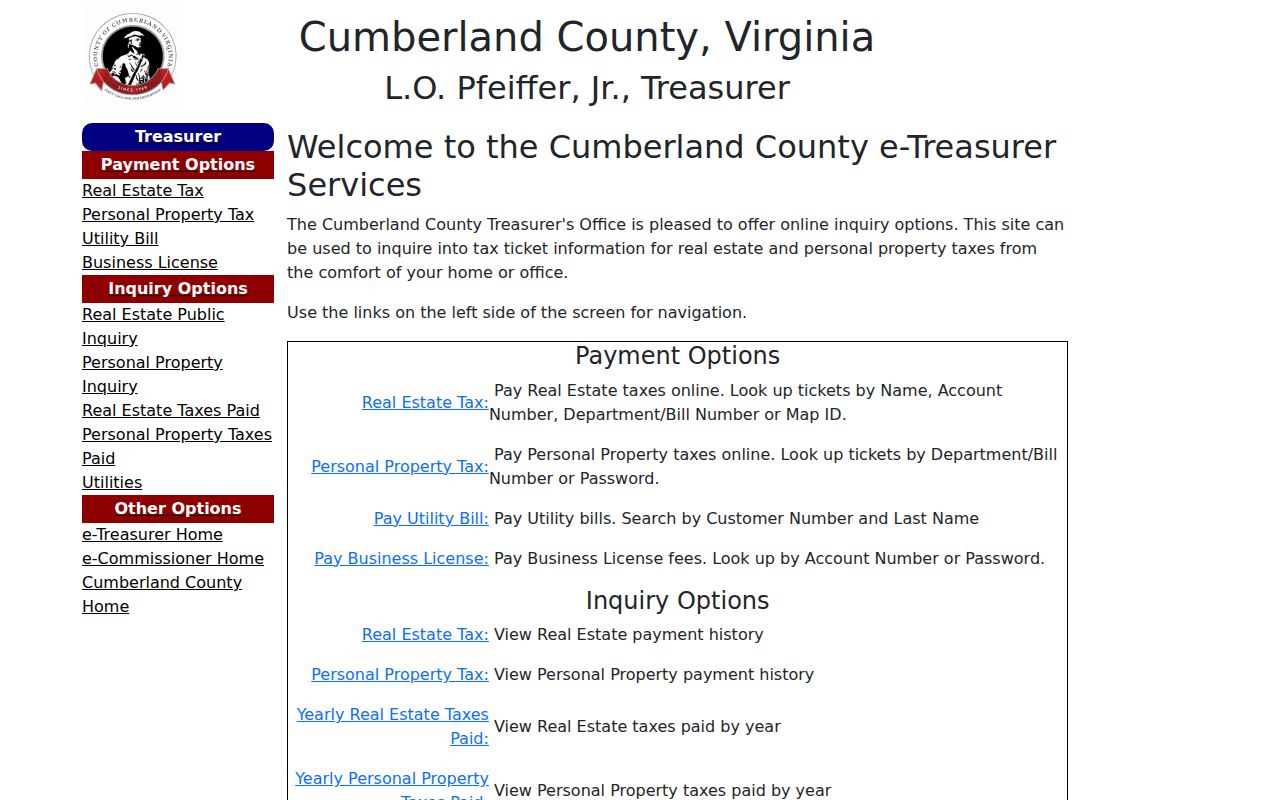
Pick the real-estate option first. Then compare the returned bill year with the payment record before calling an amount current.
The separate real-estate public inquiry can require accepting a disclaimer before its fields appear.
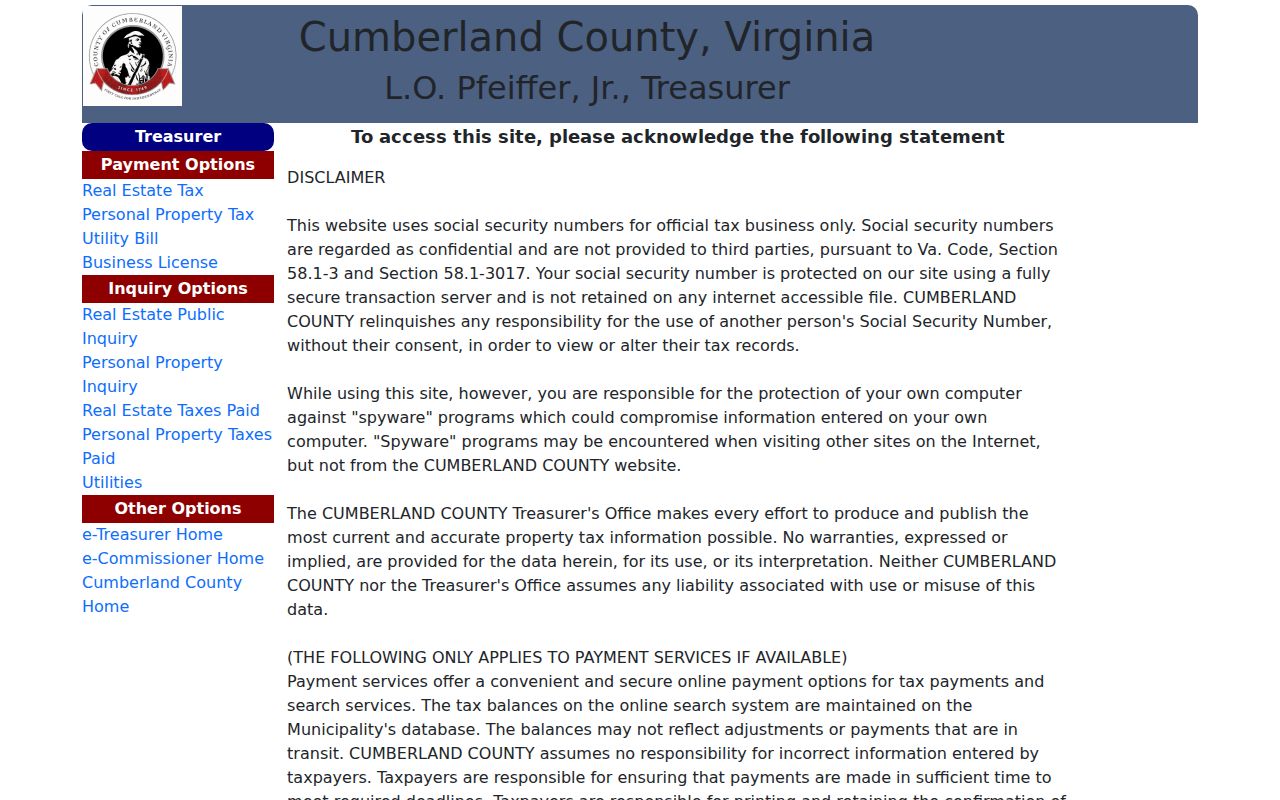
If the gate blocks your search, use the Treasurer's listed inquiry route. You can also contact the office for help with the account key.
Cumberland County offers multiple lookup keys. The payer, account, bill, and parcel rarely share one name string. A bill number from a notice is the most precise. A map ID works well. Use it to reconcile a parcel card with a tax inquiry. A name is the fallback when neither is on hand. Write down which key you used alongside the result. That way anyone can repeat the search without landing on a similarly named account.
Cumberland County Reassessment Cycle
The last general reassessment in Cumberland County took effect January 1, 2024. Values from that cycle are online. The Commissioner updates records between full reassessments. In July 2026, the county published RFP 07-2026 to hire a mass-appraisal firm. Those new values would be effective January 1, 2028. That procurement signals a planned cycle, not a current parcel-level change. Read each notice for the year and value it covers.
The official reassessment page explains the county's value-setting and notice process.
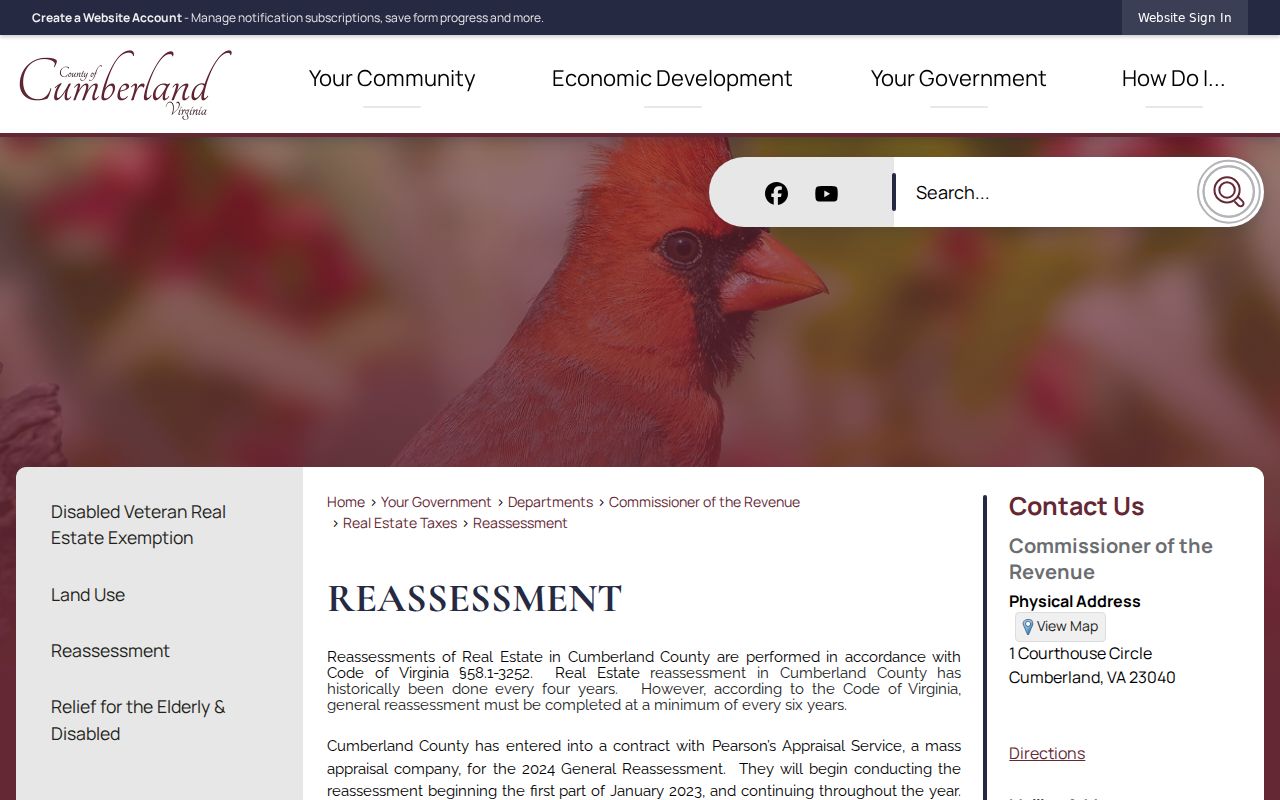
Save the reassessment notice and its comparison data if a value review may be needed. Check with the county for the current appeal calendar and form.
Tax Relief Programs in Cumberland County
Cumberland County's Commissioner of the Revenue runs several relief programs. These include Land Use, Tax Relief for the Elderly and Permanently Disabled, and the Disabled Veteran's Tax Exemption. A parcel is not enrolled just because a program exists. Verify the parcel in the assessor or land-book record first. Then ask the Commissioner about the current application, renewal rules, and eligibility. Do that before counting on any amount. The county's Commissioner of the Revenue page describes the office and its tax programs in more detail. Bill questions still go to the Treasurer. Exemption and assessment questions go to the Commissioner.
Cumberland County Rate and Delinquency
Cumberland County publishes a real-estate rate of $0.60 per $100 of assessed value. Its tax information also lists a 10 percent late-payment penalty after the due date. It adds 10 percent annual interest. Nonreceipt of a bill does not erase either one, the county says. A rate page answers a different question than a live ticket does. Check the current rate page and the Treasurer's account together for an actual balance.
A delinquent entry alone does not mean a foreclosure or tax sale happened. Review the Treasurer's account first. Then search the Circuit Court land index and any related case records for later filings. A recorded release or sale deed can change the status. It can do so after an older bill or lien entry appears. The county's tax-rate page is the source for the listed rate. The account inquiry remains the source for a parcel's current ticket.
At the published rate, every $1,000 of assessed value works out to $6 of gross annual real-estate tax. That arithmetic only explains the rate. It is not a parcel bill calculation. A bill may reflect relief, prior payments, penalties, interest, or a different tax year. Use the Treasurer's account for the amount due. Use the Commissioner's record for the assessment behind it.
Contesting a Cumberland County Assessment
Cumberland's 2024 reassessment materials explain how values are set. They also point owners to the assessment notice for appeal instructions. The county publishes no current Board of Equalization calendar, appeal form, or filing deadline. So no specific date should be inferred from the general reassessment cycle. Start with the notice for your parcel. Then contact the Commissioner to confirm the review route and the evidence the office accepts.
Useful evidence can include the assessment card and a recorded plat. Building facts and comparable property information pulled from official records can also help. Keep the year and parcel number on each item. A value dispute never changes a deed. And a payment inquiry does not resolve an assessment appeal.
Appeal window. Use the deadline printed in the current assessment notice and confirm the form and recipient with the Commissioner. The research did not verify a live county appeal calendar or filing date.