
Tracing Former Cumberland County Property Owners
A title search runs one recorded deed at a time. Move from the newest transfer to the oldest. For every deed, record the date, grantor, grantee, instrument type, and the book/page or instrument number that locates it. The source table splits modern remote access from older archival material. It works as a research worksheet, so no parcel-specific dates or party names appear here.
| Chain step | Transfer date | Grantor to grantee | Deed type and book/page |
|---|---|---|---|
| Newest recorded transfer | Copy the deed date. | Grantee is the present named party; grantor is the prior party. | Record the instrument reference. |
| Prior acquisition deed | Use the earlier deed date. | Search the former grantor as a grantee. | Keep the same parcel description in view. |
| Earlier book or reel | Use the cataloged date span. | Check spelling variants and both index sides. | Note missing or damaged index coverage. |
Start with the remote grantor-grantee index for any recent transfer. When the chain crosses the online access boundary, move to the Clerk's books or Library of Virginia microfilm. Plats tie old lot descriptions to later deeds. Turn to probate records whenever an estate or fiduciary appears in the chain.
Walking a Cumberland County Deed Chain Backward
Open with the current owner's purchase deed. That person or entity appears there as grantee. Read the grantor named on the instrument, then hunt that name as a grantee in an earlier deed. Repeat until you reach the period you need. Search both sides of the index, since joint parties, trustees, estates, and corporate names rarely line up in the expected order. Preserve recording dates and legal descriptions, because similar names alone never prove that two instruments concern the same tract.
- Identify the newest deed and verify that its legal description fits the parcel.
- Record the grantor, grantee, instrument type, date, and prior-instrument citation.
- Search the grantor as an earlier grantee and compare the land description.
- Continue through the books or reels when the online index ends or has a gap.
- Grantor and grantee
- The party who conveys and the party who receives the stated interest.
- Chain of title
- The ordered sequence of recorded transfers for the tract.
- Legal description
- The instrument's written description, which can outlast an old street name.
- Reverse index
- A party index searched from the current grantee back to an earlier grantor.
Cumberland County's 1988 Remote Cutoff
Cumberland's remote SRA/COVERS land-record access begins March 25, 1988. That date is a remote cutoff, not the county's deed start. Earlier transfers still exist. Clerk books, counter terminals, and archival microfilm can carry the chain past the boundary, and free index-only access may be enabled by the Clerk while full images require authorized subscriber accounts. The Virginia SRA portal is the online party-index route.
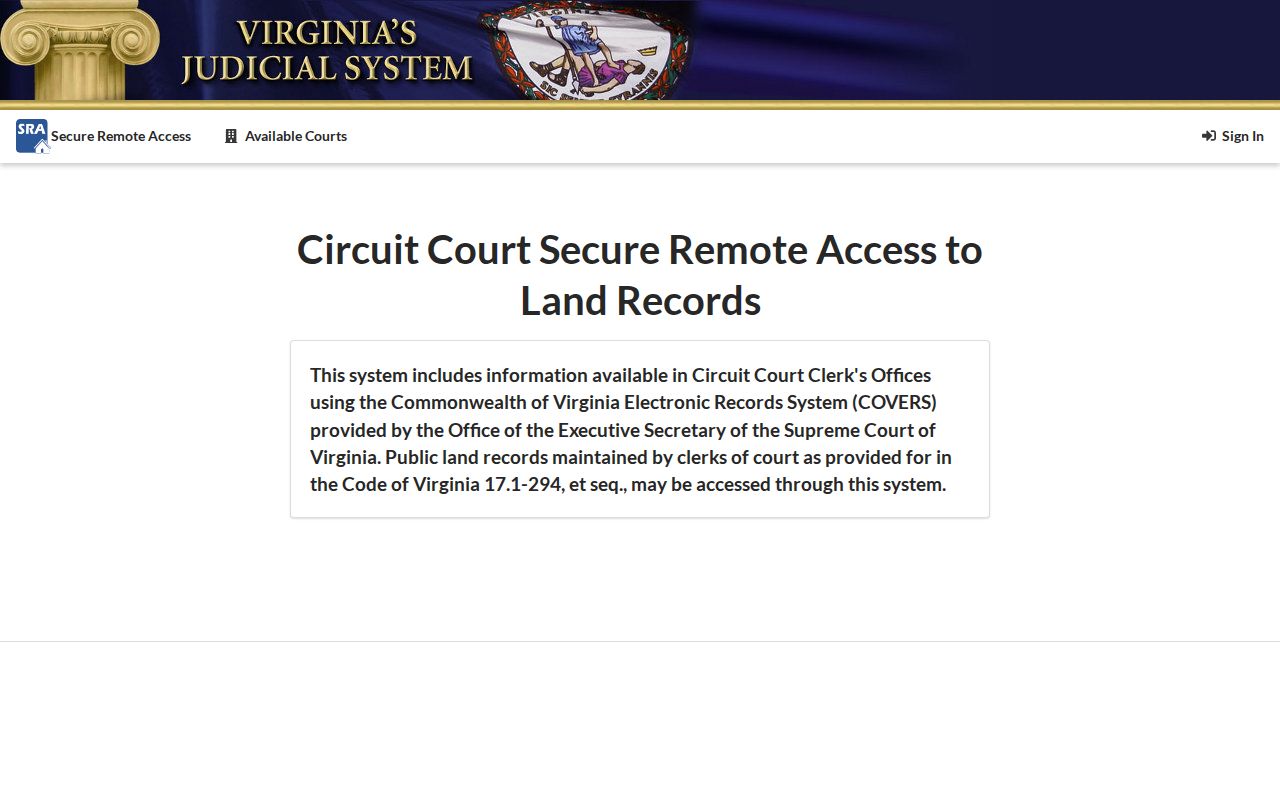
Older years call for a different step. Use the index reference to guide a Clerk or archive request rather than repeating the same online search.
Historic Cumberland County Ownership Books
The Library of Virginia holds Cumberland's earliest deeds. Deed Book 1 spans 1749 to 1752. Book 2 runs 1752 to 1760. The numbered series continues through Book 40, which closes in 1903. General grantor and grantee indexes cover 1749 to 1918. Later index material reaches 1975 for part of the alphabet, and the catalog adds Release Deed Books 1 and 2 plus land-tax books for 1883 and 1900. The Library of Virginia reel catalog identifies these spans and record types, and a deed-book date and an index date are never interchangeable.
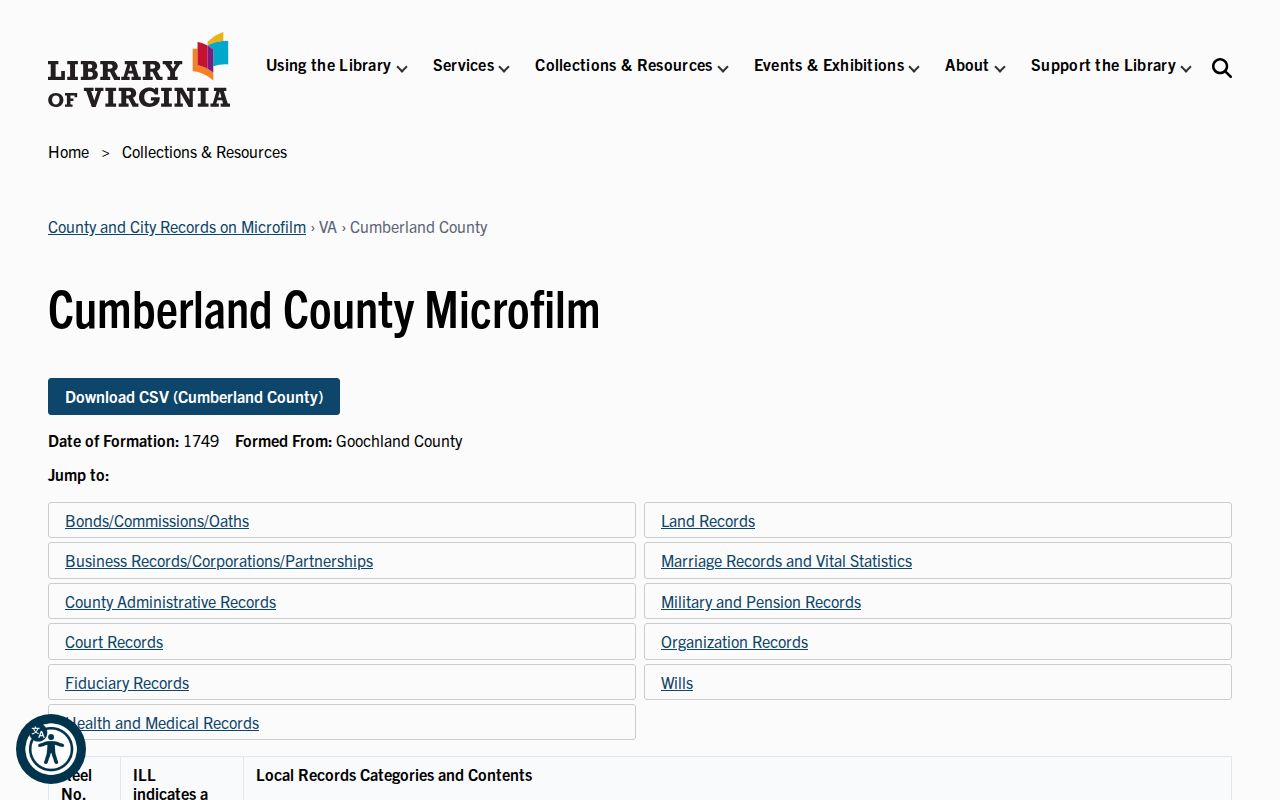
Ask for the exact book and index half matching your year and party name. Precision saves time at the desk. Deed-book ranges point to filing places. Index ranges point to party locators. Keep the catalog reference beside each name searched. Note its grantor or grantee role. Also note the date span requested. Release deed books can show whether an earlier security interest was discharged. Land-tax books add a historical clue about a parcel. They never substitute for its conveyance deed.
Split Indexes for Cumberland County Names
The 1749 to 1918 general index comes in halves. Grantors and grantees each get separate A-K and L-Z runs at the Library of Virginia. A later grantee segment runs 1918 to 1975. The catalog lists W-Z for that segment. Check the right role and alphabet half before deciding a search failed. Spellings vary. Initials and name order can differ between deeds too. Note the index series, letter range, party role, and date each time you search, then pull the referenced deed book, since the index entry is only a locator. A recent deed that cites a prior instrument works well as a bridge into an unfamiliar historic volume.
Known Gaps in Cumberland County Deed Books
The catalog flags Deed Book 1-A, spanning 1809 to 1827, as not fully covered by the general index. Deed Book 3 is mutilated. Both limits can interrupt a clean name search. Try variant spellings. Inspect the book directly where possible. Later deeds, plats, release deeds, and land-tax books may offer a separate path through the gap. The county has no official account of a courthouse fire or mass records loss. Never invent one. Record the exact gap. Keep it distinct from a proven conveyance. The Clerk or the Library of Virginia can say which surviving volume remains open for consultation. For a weak span, write down the volume you inspected and what it actually held. Indexes omit names, old handwriting resists reading, and a later document may cite an earlier instrument under another spelling; an honest chain admits those limits instead of treating an empty search as proof that a transfer never happened.
Probate Transfers in Cumberland County
An estate can rewrite a deed chain without any sale taking place. Wills, fiduciary bonds, and executor deeds all pass title. So do administrator deeds, court orders, and partition suits. The Circuit Court Clerk holds these papers. The county genealogy page lists wills and order books among its holdings. Trace a decedent's name forward to an executor or heir named as grantee. Then compare the legal description and parcel number so the file matches the land in question.
Keep limits in mind. Death certificates are not title instruments. Certified copies stay restricted before the statutory opening period. Probate files can also hold sealed material. Rely on the property records for the conveyance itself. Let the estate record explain the authority behind it.
How Far Back Cumberland County Ownership Records Go
Cumberland County was formed in 1749 from Goochland County. The Library of Virginia's Deed Book 1 opens that same year. So the county's deed records run from the very start. An even earlier clue exists: a 1723 Thomas Randolph patent on Willis Creek. To build a parcel chain, start with the newest recorded deed. Work backward on both the grantee and grantor sides. Then pull in the named books, indexes, plats, tax rolls, and estate records as the era demands.
The courthouse complex and the historic Cumberland Courthouse district help orient a house-history search. Still, a local story is not an ownership record. Each link in a chain must rest on instrument descriptions and the archival catalog. If no matching deed survives, say so plainly. If the index has gaps, say so plainly too. Do not assert an unbroken chain.
Any claim that a parcel changed hands before 1749 requires work beyond the county's first deed book. That means archival digging further afield. Cumberland's split from Goochland and the earlier Randolph patent are useful leads. Neither one proves ownership of a modern tax parcel. Tie every pre-1749 reference to a matching land description. Then tie it to a later conveyance before counting it in the chain.
Lawful use. Former-owner research in Cumberland County supports house history and property diligence. Do not use names or addresses to track, threaten, or harass a living person.